Imsouane vs Taghazout: Which Moroccan Surf Town Is Right for You?
By Kamal, KAZA Wave Founder — Surf Coach & Camp Owner·July 20, 2026·10 min read
Imsouane vs Taghazout is the question almost every surfer asks when planning a Moroccan trip. Both sit on the same Atlantic coast, both deliver right-hand point breaks, but they serve very different surfers. This guide breaks down the differences in wave, vibe, cost, and logistics so you can pick the right one before you book a flight, drawn from 15 years living in Imsouane and dozens of trips down the coast to Taghazout.
Imsouane is better for most beginners. The inside section of Imsouane Bay is slow, knee-to-chest high, and breaks over sand — one of the safest learning waves in Morocco. Taghazout has beginner spots (Banana Beach, Hash Point) but they are busier and shorter.
Which town has more wave variety?
Taghazout. Within 15 km you have Anchor Point, Killer Point, La Source, Mysteries, Hash Point, Banana Beach, Devil's Rock, and Boilers. Imsouane has only two named breaks: the Bay and Cathedral. If you want options for different swell directions and levels, Taghazout wins.
How far apart are Imsouane and Taghazout?
About 100 km, or 1 hour 30 minutes by road along the N1 coastal highway. The drive is paved and scenic. Many travelers split a 10+ day trip between both towns to experience both wave styles and atmospheres.
About the author
Kamal, KAZA Wave Founder — Surf Coach & Camp Owner. Kamal has lived and surfed in Imsouane for over 15 years. He runs KAZA Wave Surf Camp and teaches longboard surfing to travelers from around the world.
Plan your trip
Book your KAZA Wave surf experience
Small groups, certified coaches, and a wave that breaks for everyone — from beginner to longboard intermediate.
If you want the longest possible ride and a quiet fishing village, choose Imsouane. If you want wave variety, performance shortboarding, and a busier social scene, choose Taghazout. Beginners and longboarders skew toward Imsouane. Intermediate-to-advanced shortboarders skew toward Taghazout. Most travelers who can stay 10+ days end up doing both — 4 nights in one, 4 in the other — which is the answer if your dates allow it.
Definition: A point break is a wave that wraps around a headland and peels in one direction, allowing rides far longer than a beach break. Both Imsouane and Taghazout are point-break towns.
Imsouane is a fishing village of around 1,200 residents perched above two coves: Magic Bay (the harbor) and Cathedral Beach. It sits 80 km north of Agadir and 130 km south of Essaouira. There is one main road, no nightclub, no chain hotel, and one tiny supermarket. The economy runs on sardine fishing and a handful of family-run surf camps and guesthouses.
Taghazout is a former fishing village now reshaped by 25 years of surf tourism. Population is roughly 5,000 and rising. The town has a paved corniche, dozens of surf shops, several beach bars, and a major resort development (Taghazout Bay) just north of the village proper. Within a 15 km radius you find Anchor Point, Killer Point, La Source, Mysteries, Hash Point, Banana Beach, Devil’s Rock, and Boilers — eight named breaks, each with its own swell and wind window.
Imsouane village perched above the harbor — fishing boats, white houses, no resort strip.
Wave & Skill Level
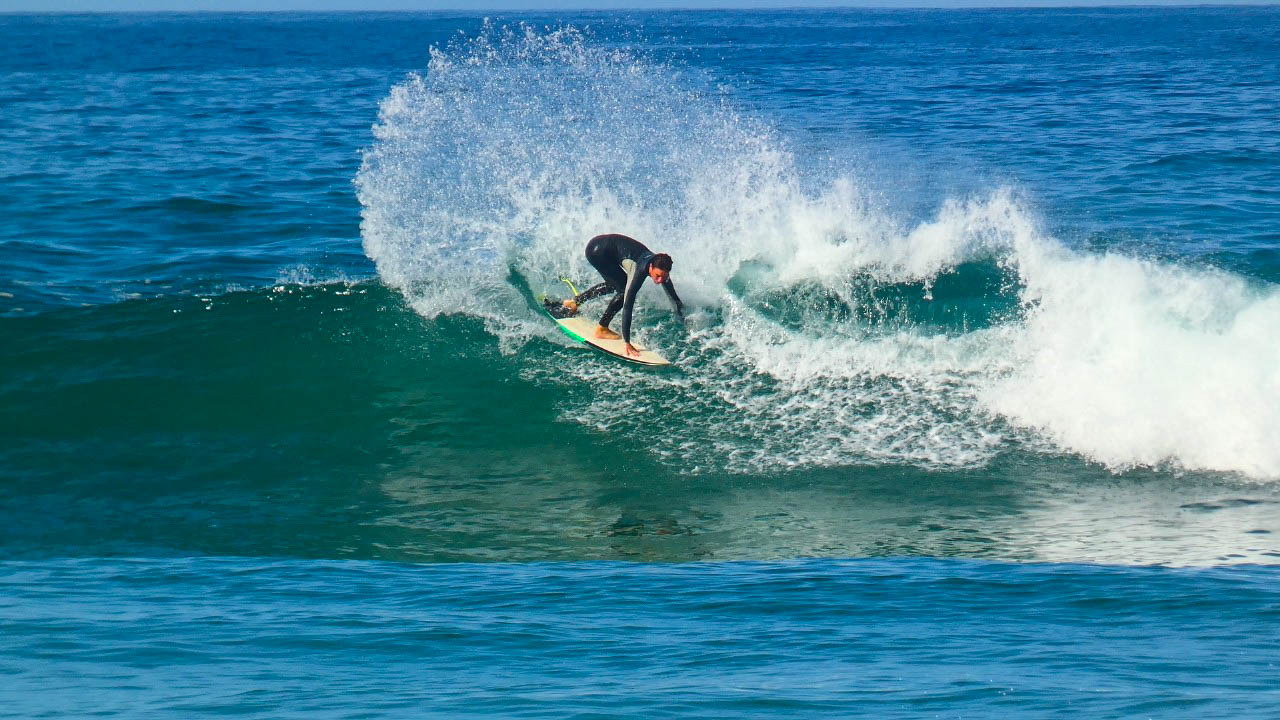
The wave is the single biggest reason to choose one town over the other. Imsouane Bay is slow, mellow, and forgiving — a wave shaped for learning and for longboarding. Taghazout’s marquee break, Anchor Point, is fast, walled-up, and demands a clean takeoff and a competent shortboarder. The two waves are the opposite ends of the right-hand point break spectrum.
Imsouane’s Bay handles 2 to 8 feet, peaks in the 3-to-6-foot range, and breaks over a sand-and-rock bottom that is forgiving on the inside. The wave has three sections — outside, middle, inside — and a single ride can run 600 meters on a 4-foot day, 800 meters on a clean 6-foot day. Cathedral, Imsouane’s secondary spot, is a punchier left point that holds bigger swell and suits more advanced surfers, but it is rarely as crowded as the bay.
Taghazout’s wave map is broader. Anchor Point is the headline performance wave — a fast right that runs 200-300 meters on a clean day with a hollow takeoff. Killer Point further north handles size and is the area’s biggest-wave option. Banana Beach and Hash Point are softer, more beginner-friendly. La Source is a reef wave with a punchy takeoff. The variety is the draw — you can drive 10 minutes north or south and find a wave matched to the day’s swell direction and your level.
Beginners — Imsouane’s inside section is the safer, longer learning environment. Taghazout’s beginner waves (Banana, Hash) work but are busier and shorter.
Improvers — Imsouane gives you the longest practice wall in the country. Taghazout gives you variety to match your improving skill set.
Longboarders — Imsouane is built for you. Taghazout works but is less ideal — most spots are too fast or too crowded for cruising.
Shortboarders — Taghazout wins on most days. Imsouane shines only on clean 5-to-6-foot days when the outside section turns on.
This is where the towns diverge most. Imsouane is quiet. The harbor wakes up at 5:00 with the fishing fleet and goes still after sunset. There are no bars in the village and only a handful of cafes. Most evenings, surfers eat at their camp dining room and are in bed by 22:00 because the morning session starts at 8:00. The social scene is camp-based — your dinner table is your social circle for the week.
Taghazout has a louder pulse. The corniche has 10+ cafes that stay open until midnight, three or four beach bars (some with DJs in season), yoga studios, smoothie spots, surf shops, and crowds of European van-lifers parked along the coast road. The social scene is town-wide — you bump into surfers from other camps at the same coffee shops every morning. For some travelers this is the appeal. For others it is exactly what they came to Morocco to escape.
Imsouane vs TaghazoutThe coast between Agadir and Essaouira — empty stretches like this define the quieter Imsouane experience.
If you are traveling solo and want to meet other surfers easily, Taghazout makes that easier. If you are traveling as a couple or in a group and want a focused surf-and-rest week, Imsouane is more aligned with that intent. We have hosted plenty of solo female travelers at our camp who chose Imsouane specifically for the quieter, more contained environment.
Accommodation & Food
Both towns offer the full range from dorm bed to private apartment, but the numbers and prices differ.
Imsouane’s accommodation map covers maybe 25 places total. A dorm bed runs 15-25 EUR a night, a private double 35-60 EUR, a self-catering apartment 70-120 EUR. Most accommodations are family-run. Half-board (breakfast and dinner) is standard at surf camps because there is no supermarket and few restaurants. Our camp accommodations follow the same model — three room categories, half-board included.
Taghazout has hundreds of options across the village and the resort area to the north. Dorm beds start around 12 EUR, doubles 30-80 EUR, apartments 60-200 EUR depending on proximity to the corniche. The resort area (Taghazout Bay) pushes well above 200 EUR for branded hotels. Self-catering is more practical because there are several supermarkets and dozens of restaurants. The food scene is much wider — wood-fired pizza, sushi, smoothie bowls, French bistros, and the standard tagine and grilled fish.
Imsouane’s food scene is short but honest. Four grilled-fish shacks at the harbor (60-80 MAD for a full plate of fresh sardines, calamari, or red mullet), two tagine restaurants in the village, a couple of breakfast cafes, and the dining rooms of the surf camps. There is no pizza, no sushi, no third-wave coffee. If that matters to you, Taghazout wins on food. If you want fresh fish unloaded from the boat that morning, Imsouane wins.
Getting Around
Imsouane is walkable end-to-end in 15 minutes. From any guesthouse to the harbor where the surf school meets is a 5-to-10-minute walk downhill. There is no taxi service in the village proper — for trips out you arrange with your camp or a freelance driver. The road into town is a single switchback off the N1, paved and well-maintained but slow at night.
Taghazout has more infrastructure: petit taxis run within the village, grand taxis run between Taghazout and Agadir for 5-10 EUR per seat, and several rental car agencies operate from the corniche. To reach the surrounding breaks (Anchor, Killers, La Source) you either rent a car, use a camp shuttle, or grab a taxi for 30-100 MAD per trip. The road network is denser and the spots are spread out, so most surfers want wheels for at least part of the trip.
Distance from the closest airport is the headline logistics number. Agadir Al-Massira (AGA) sits 20 km from Taghazout (30 minutes) and 80 km from Imsouane (1 h 15). The KAZA Wave airport transfer is 60 EUR per trip up to 4 people. Taghazout transfers run 30-40 EUR. For step-by-step transport detail, see how to get to Imsouane.
Side-by-Side Comparison
Criterion
Imsouane
Taghazout
Wave length
Up to 800m (Magic Bay)
50-300m (Anchor Point)
Best skill level
Beginner to intermediate, longboard
Intermediate to advanced, shortboard
Crowd density
Medium, peaks in December
High year-round in season
Vibe
Quiet fishing village
Busy surf town with corniche
Accommodation cost (dorm/double)
15-25 / 35-60 EUR
12-20 / 30-80 EUR
Food cost (full meal)
6-10 EUR (limited variety)
5-15 EUR (wide variety)
Distance from Agadir airport
80 km / 1 h 15
20 km / 30 min
Party scene
None — no bars in village
Several bars, occasional DJs
Optimal swell window
3-6 ft NW-W
4-8 ft NW
Recommended board
Longboard or mid-length
Shortboard or mid-length
Number of named breaks
2 (Bay + Cathedral)
8+ within 15 km
Year-round residents
~1,200
~5,000
The pattern: Imsouane wins on wave length, quiet, and learning safety. Taghazout wins on variety, social scene, and proximity to the airport.
The middle section of the Bay — long, slow, and built for cross-stepping or trim practice.
After a few hundred guests booking either side of this question, the patterns are clear:
First-time surfers — Imsouane. Inside section, soft beginner waves, smaller crowds, a single coach team you stay with for the week. Our surf school is built around this.
Longboarders — Imsouane, no contest. The bay is among the best logging waves in the world. Our longboard experience targets this directly.
Intermediate shortboarders chasing performance waves — Taghazout. Anchor Point, Killer Point, and the variety of surrounding spots match what you came for.
Surfers who want nightlife — Taghazout. Imsouane has none.
Digital nomads — Taghazout has more cafes with reliable WiFi. Imsouane has fiber at most camps but a thinner cafe scene. See our digital nomad guide to Imsouane.
Anyone with 10+ days — Do both. Split the week. Drive between in 1 h 30. The contrast makes both stronger.
If you are still on the fence, send us your dates and current surf level — we will give you a straight answer about whether Imsouane fits or whether you would be better off in Taghazout. We would rather you go to the right place than the place that pays our bills.
Is Imsouane cheaper than Taghazout?
Marginally, on food. Accommodation pricing is similar at the dorm and double level. Imsouane food costs less because most surf camps include half-board (breakfast and dinner) and there are fewer restaurant temptations. Taghazout has more variety but more total spending temptation.
Which town is better for longboarders?
Imsouane, by a wide margin. The Bay's slow, mellow wall is built for cross-stepping and noseriding — among the best logging waves in the world. Taghazout's spots are mostly too fast, too crowded, or too punchy for traditional longboarding.
Does Taghazout have nightlife?
Yes, modestly. Three or four beach bars stay open until late, with occasional DJs in season. The corniche has cafes open until midnight. Imsouane has no bars, no clubs, and the village goes quiet after sunset — most surfers are in bed by 22:00 to make the morning session.
Which town has better food?
Taghazout has more variety — pizza, sushi, smoothie bowls, French bistros, plus tagines and grilled fish. Imsouane is limited to grilled-fish shacks at the harbor, two tagine restaurants, and the camp dining rooms. For freshness off the boat, Imsouane wins. For breadth of options, Taghazout wins.
Should I do both Imsouane and Taghazout in one trip?
If you have 10+ days, yes. Splitting 4 nights at each town gives you both wave styles — long mellow logging waves at Imsouane and performance shortboarding at Taghazout — with one easy 1 hour 30 minute drive between. We help guests build split itineraries when asked.
Imsouane vs Taghazout: Which Moroccan Surf Town Is Right for You? | KAZA Wave Blog | KAZA Wave Surf Camp
.jpg)

.jpg)