Digital Nomad Guide to Imsouane: WiFi, Cafés & Co-living in 2026
By Kamal, KAZA Wave Founder — Surf Coach & Camp Owner·July 21, 2026·9 min read
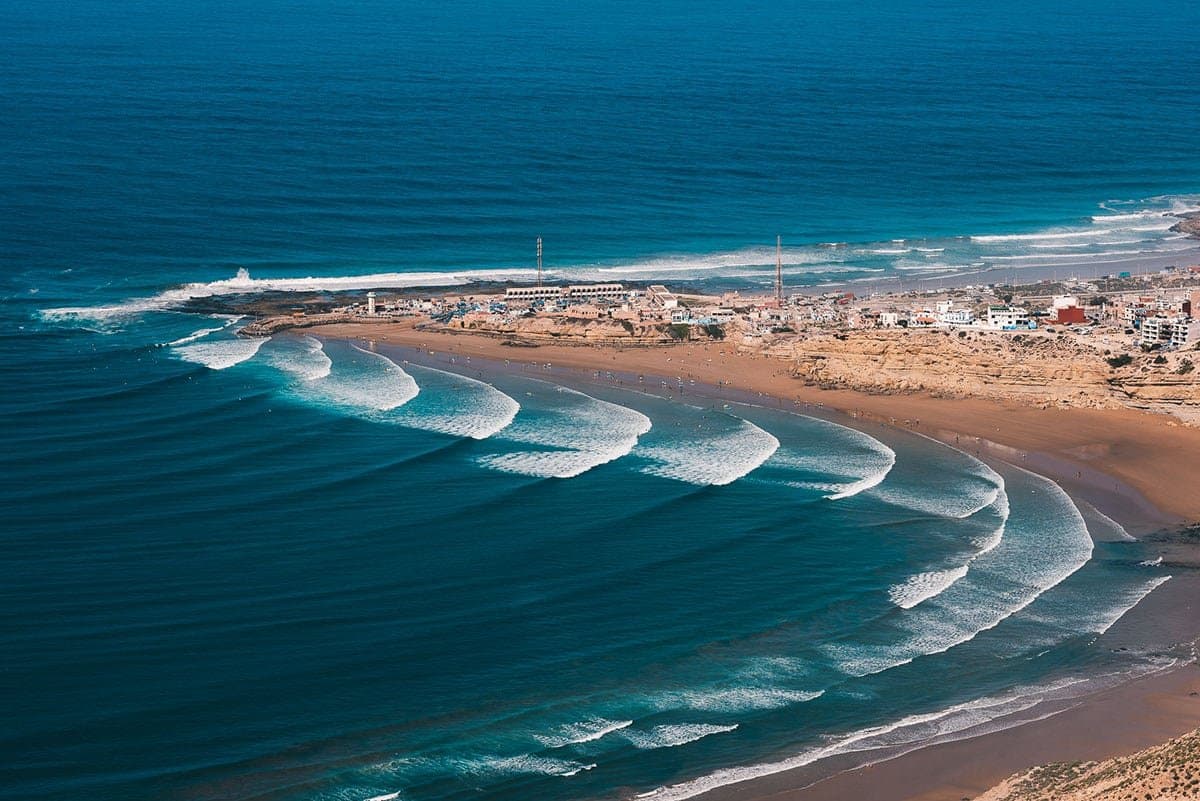
Digital nomad Imsouane is a real possibility in 2026, but it comes with trade-offs that the bigger Moroccan nomad hubs (Taghazout, Tangier, Marrakech) do not have. The village is small, the cafe scene is thin, and WiFi quality varies sharply between camps. The upside: you wake up to the longest right-hand wave in Africa 200 meters from your laptop. This guide covers what remote work actually looks like in Imsouane today, drawn from hosting nomads at our camp for the past 5 years.
Is the WiFi good enough for remote work in Imsouane?
Yes at most surf camps. Fiber arrived in 2022 and our camp runs 100/20 Mbps with 4G failover — reliable for video calls and uploads. Older guesthouses run on 4G LTE at 15-30 Mbps which works for email and Slack but is marginal for video. Confirm with your accommodation before booking.
Are there coworking spaces in Imsouane?
No dedicated coworking spaces yet. Nomads work from surf camp common areas (rooftops, dining rooms during off-hours), one of three or four harbor cafes, or their own rooms. Most camps including ours offer day passes for non-guests at around 50 MAD per day with WiFi and coffee.
How much does it cost to live in Imsouane as a nomad?
Budget nomads spend around 600-700 EUR per month including dorm accommodation and modest food. Mid-range nomads in a private room land around 1,000-1,200 EUR. Comfortable apartment-based nomads spend 1,500-1,800 EUR per month. About half the cost of Lisbon or Las Palmas at equivalent quality.
About the author
Kamal, KAZA Wave Founder — Surf Coach & Camp Owner. Kamal has lived and surfed in Imsouane for over 15 years. He runs KAZA Wave Surf Camp and teaches longboard surfing to travelers from around the world.
Plan your trip
Book your KAZA Wave surf experience
Small groups, certified coaches, and a wave that breaks for everyone — from beginner to longboard intermediate.
The case for Imsouane over Taghazout or Tangier is specific. You come here to surf as much as to work. The wave is consistent enough that a 6:30 alarm gives you 90 minutes in the water before the EU work day starts. The village is small enough that distractions — coffee runs, errands, gym sessions — take 10 minutes round trip instead of 40. The cost of living is low enough that a month here costs less than a week in Paris or Berlin. The trade-off is that nightlife, cafes, and broader social scene are limited compared to the bigger nomad hubs.
Most nomads who stay long-term in Imsouane fit one of three profiles: surfers who already work remotely and want to optimize for water time; writers and developers who need a quiet rural setting to focus; and burned-out city dwellers looking for a 4-6 week reset that combines surf, yoga, and cheaper living. If you need 5 different cafes to rotate between or you thrive in a high-density social scene, Taghazout will serve you better.
The rooftop at our camp — fiber WiFi, sea view, and a 5-minute walk to the lineup. Where most of our nomads end up working from.
Definition: Fiber-to-the-home (FTTH) reached Imsouane in 2022. Most surf camps and guesthouses now offer fiber connections at 50-100 Mbps download speeds, with the rest still running on 4G LTE backup at 20-40 Mbps.
Honest numbers based on speed tests we run quarterly across the village:
KAZA Wave camp — fiber 100/20 Mbps with a 4G failover. Reliable for video calls and large file uploads. We tested this specifically because we host nomads.
Other surf camps with fiber — speeds typically 50-80 Mbps, varying by time of day. Evening peak (20:00-23:00) sometimes drops to 20-30 Mbps when guests stream.
Older guesthouses on 4G only — 15-30 Mbps. Fine for email and Slack, marginal for video calls, painful for video uploads.
Cafes — most run on 4G or older DSL. Speeds 10-25 Mbps. Acceptable for an hour of work, not a full day.
Power cuts are infrequent but real — 2-4 brief outages per year in winter storms. Most camps run on grid power without UPS backup. If your work cannot tolerate a 20-minute outage, you need a personal mobile hotspot as backup. Maroc Telecom and Orange both sell unlimited data SIMs for around 200 MAD per month — worth the investment for any stay over two weeks.
Latency to European servers is around 30-50ms — fine for Zoom, Google Meet, and most video conferencing. Latency to US east coast is 100-130ms, US west coast 150-180ms. Acceptable for calls but not for any latency-sensitive work like real-time gaming or live audio production.
Best Cafés to Work From
Honest answer: Imsouane has no dedicated coworking cafe in the way Taghazout has Munga or Smile Cafe. The village has maybe four cafes that work for laptop sessions, all near the harbor.
Café Magic Bay — overlooks the lineup. Works for short sessions (1-2 hours). Power outlets limited. Best in the morning before it fills with surfers checking the conditions.
Café Imsouane Nord — quieter, slightly inland. Better for focused work. WiFi is older 4G but stable. Good coffee and they tolerate long sessions if you order food at lunch.
Surf camp dining rooms (during off-hours) — most camps including ours let day-pass guests use the dining room as a workspace between meal services. We charge 50 MAD a day for non-guest day passes including coffee and water.
Your own room — for serious 6-hour work sessions, your room is the answer. Most camps have desks or workable surfaces.
Digital Nomad Guide to ImsouaneThe kind of view nomads rave about — empty coast, no traffic noise, and a horizon that doesn’t compete with your screen.
If your work requires constant cafe rotation, Imsouane will not satisfy. If you can settle into one or two spots with predictable WiFi and routine, the village works well.
Co-living Options at KAZA Wave
We do not run a formal “co-living” product but several of our packages function that way in practice. Long-stay nomads typically book one of three options:
Surf School + extended stay — book the surf school week for the first week, then extend on a room-only or half-board basis at reduced rates. Mornings surf, afternoons work, evening dinners with new guests.
Surf & Yoga retreat with longer stay — our surf and yoga package works as a 7-day reset, with extension at the same accommodation rate beyond. Suits nomads who want morning yoga as part of their routine.
Self-catering apartment — for nomads bringing partners or wanting full kitchen access, the apartment option with monthly rates makes sense. Pricing 600-900 EUR per month depending on season.
Our common spaces (rooftop, dining room, garden) are open through the day. Most nomads find their work rhythm in the first week and settle into a pattern: dawn surf, breakfast at the camp, work through the morning, lunch, light afternoon errands or a yoga class, evening at the camp dining table. We have hosted writers, software engineers, designers, marketers, and a couple of online therapists over the years.
For a sense of how a typical week unfolds at the camp end-to-end, see the KAZA Wave guest journey article.
Time Zone & Work Schedule (GMT+1)
Morocco runs on GMT+1 year-round (since the country dropped daylight saving in 2018, with the exception of a 1-hour shift during Ramadan). The schedule advantages depend on your team’s location:
EU teams (Paris, Madrid, Berlin) — same time zone, no offset. Standard 9-17 day overlaps fully.
UK team — 1 hour ahead of London (GMT). Minor offset, no real impact on schedules.
US East Coast team — 5 hours ahead of EST. You start your day before they wake up, overlap from 14:00 your time. Surfing in the morning works perfectly with East Coast collaboration.
US West Coast team — 8 hours ahead of PST. Overlap window is 17:00-22:00 your time. Surfing morning, working evening. Some nomads love this; some find it isolating.
Asia-Pacific teams — challenging. APAC overlap requires very early starts.
For most EU and US East Coast remote workers, Imsouane’s time zone is genuinely advantageous: morning surf, late-morning team standup, afternoon focus work, evening overlap with US East Coast colleagues. We see this most often in our developer and consulting nomad guests.
The dining room between meals — where most of our nomad guests settle in for focused work blocks during the day.
Cost of Living
Imsouane is one of the cheapest digital nomad bases in Morocco. Rough monthly numbers based on guests we’ve hosted:
Expense
Budget (MAD/month)
Mid-range (MAD/month)
Comfortable (MAD/month)
Accommodation
3,000 (dorm bed)
5,500 (private double)
9,000 (apartment)
Food (mostly camp + grilled fish)
2,500
3,500
5,000
Surf rental + sessions
800
1,500
2,500
Transport (occasional grand taxi)
200
500
1,500 (rental car shared)
Phone/data SIM
200
200
200
Total per month (MAD)
~6,700
~11,200
~18,200
Total per month (EUR)
~610
~1,020
~1,650
Most nomads land in the 1,000-1,500 EUR per month range, which compares to 2,000-3,500 EUR per month for similar quality in Lisbon or Las Palmas.
Most EU, UK, US, Canadian, Australian, and New Zealand passports get 90 days visa-free on arrival in Morocco. Verify against your nationality on the Moroccan consulate website before flying. The 90 days is per entry, not per year — but in practice, nomads who do a full 90-day stretch typically need to leave and re-enter.
The standard re-entry approach is a “border run”: fly to Spain (Malaga, Seville, Madrid), Portugal (Lisbon), or another nearby country for 1-3 days, then re-enter Morocco for another 90 days. Most flights from Agadir to Spain are 60-150 EUR round-trip. We have guests who do this twice a year and effectively spend 6 months in Imsouane annually.
For longer stays, Morocco does not currently offer a dedicated digital nomad visa, but a “Carte de Séjour” (residence permit) is available after a year. This is more relevant for guests who decide to base themselves in Morocco long-term. The application is bureaucratic and usually requires a local sponsor or property lease — most nomads do not bother.
Practical tip: keep your entry stamp clean and photographed. Morocco’s border control is generally professional but inconsistent — a clean record of stays helps if you ever face questions on re-entry.
If Imsouane sounds like the right kind of base for your remote work and surf life, message us with your dates and approximate budget. We will give you a straight answer about whether the camp suits your work setup, and quote a long-stay rate that reflects the duration. The right nomads love this place; the wrong ones leave after a week. We would rather know which you are before you commit.
What time zone is Imsouane in?
Morocco runs on GMT+1 year-round (with a 1-hour shift during Ramadan). This is ideal for EU teams (no offset), good for UK and US East Coast (1 and 5 hour offsets respectively), and challenging for US West Coast (8 hours behind) and Asia-Pacific.
Can I stay in Morocco for 90 days as a nomad?
Yes. Most EU, UK, US, Canadian, Australian, and NZ passports get 90 days visa-free on arrival. For longer stays, do a border run to Spain or Portugal (1-3 days) and re-enter for another 90 days. Morocco does not currently offer a dedicated digital nomad visa.
What about power cuts in Imsouane?
Power cuts are infrequent — typically 2-4 brief outages per year in winter storms. Most camps run on grid power without UPS backup. If your work cannot tolerate a 20-minute outage, get a Maroc Telecom or Orange unlimited data SIM (~200 MAD/month) as a personal hotspot backup.
Is Imsouane better than Taghazout for remote work?
It depends on your priorities. Imsouane is quieter, smaller, and the wave is right outside the camp — better for surf-focused nomads who want focus and don't need a big social scene. Taghazout has more cafes, dedicated coworking, and a denser nomad community. Many nomads try both.
Can I rent a long-stay apartment in Imsouane?
Yes. Self-catering apartments at our camp run 600-900 EUR per month depending on season for a 1-2 bedroom unit. Other guesthouses in the village offer monthly rates from around 500 EUR for basic apartments to 1,200 EUR for larger sea-view units. Most negotiable for stays over a month.
Digital Nomad Guide to Imsouane: WiFi, Cafés & Co-living in 2026 | KAZA Wave Blog | KAZA Wave Surf Camp
.jpg)


.jpg)

.jpg)