Rock Climbing and Surfing in Morocco: A Multi-Sport Adventure
By Kamal, KAZA Wave Founder — Surf Coach & Camp Owner·July 12, 2026·8 min read
Climbing and surfing morocco is a combination more travelers ask about each year, and the geography genuinely supports it. The Atlas range and the Anti-Atlas hold some of the best traditional climbing in North Africa, while Imsouane delivers a long, mellow point break two to four hours west. We have hosted climbers running surf-recovery weeks at the camp every season since 2019. This guide covers why the pairing works, where to climb, and how to combine it with a realistic surf week without overloading the body.
Can I climb in Morocco and surf in Imsouane on the same trip?
Yes. The cleanest version is 10 days combining 5 nights of surf at Imsouane with 4 nights of climbing in the Anti-Atlas around Tafraout. The drive between them is 5 hours, the seasons overlap (November-March), and the recovery between disciplines balances naturally.
Where is the best climbing close to Imsouane?
Tafraout and Jebel Kest in the Anti-Atlas — 5 hours southeast of Imsouane. Hundreds of trad routes from 4a to 8a, granite pinnacles, dramatic desert setting. Best November to March when temperatures are perfect. Local guidebook: 'Climb Tafraout' by Steve Broadbent.
Is Taghia worth the long approach for a multi-sport trip?
Only for serious climbers. Taghia is a remote High Atlas canyon reached by a 3-hour donkey approach from the road. The walls are 300-700 meters of limestone with classic long trad routes. It is one of the best limestone destinations in Africa but adds 4-5 days to any combo trip.
About the author
Kamal, KAZA Wave Founder — Surf Coach & Camp Owner. Kamal has lived and surfed in Imsouane for years. He runs KAZA Wave Surf Camp and teaches longboard surfing to travelers from around the world.
Plan your trip
Book your KAZA Wave surf experience
Small groups, certified coaches, and a wave that breaks for everyone — from beginner to longboard intermediate.
Definition: A multi-sport trip combines two or more disciplines in a single travel window, using shared logistics and overlapping seasons to make the journey worthwhile for both activities.
Morocco’s geography puts world-class limestone within a half-day drive of one of Africa’s longest right-hand point breaks. The same flight into Marrakech (RAK) or Agadir (AGA) or Essaouira gets you to both, and the seasons overlap — autumn through spring is prime for both Atlantic surf and inland climbing.
Climate — coastal Imsouane is mild year-round (15-25°C). Anti-Atlas zones (Tafraout, Jebel Kest) work best November to March when the desert is cool.
Cost — substantially cheaper than European climbing destinations and dramatically cheaper than US trad meccas. Two weeks here costs roughly one week in Yosemite.
Crowds — both scenes are small. Famous climbing canyons see a handful of teams; Imsouane peaks only at Christmas.
Visas — EU, UK, US, and Canadian passports enter visa-free for 90 days.
Climbing Spots Within Reach
Three regions matter for travelers basing a multi-sport trip on Imsouane. They run in increasing order of remoteness and commitment.
Anti-Atlas (Tafraout, Jebel Kest)
The closest world-class climbing to Imsouane. Drive time from the camp: 5 hours southeast. The Anti-Atlas is a sandstone-and-quartzite zone with hundreds of trad routes from 4a to 8a, dramatic granite pinnacles, and a Berber village base in Tafraout. Best season is November through March — desert temperatures are perfect in winter, brutal in summer.
Style — predominantly traditional (placed gear), some bolted sport routes added in the last decade.
Grades — 4a to 8a, with the bulk in the 5a-6c trad range.
Approach — short, mostly under 30 minutes from parked cars.
Logistics — Tafraout has guesthouses (50-80 EUR/night), small restaurants, and a couple of climbing-friendly cafes. Climbing guidebook: “Climb Tafraout” by Steve Broadbent.
Todra Gorge
The most famous climbing destination in Morocco, four hours east of Marrakech in the eastern High Atlas. From Imsouane the drive is 8-9 hours, so it is realistic only as part of a longer multi-sport itinerary, not as a daily commute. Todra is limestone, mostly bolted sport climbing, with some long trad lines.
Style — primarily sport (bolted), with classic trad lines on the longer walls.
Grades — 5a to 8c, deep selection in 6a-7a.
Approach — minutes from the road in most cases.
Logistics — gorge-bottom hotels, restaurants, and gear-friendly campsites. Best in spring (March-May) and autumn (September-November); summer is too hot, winter too cold for some sectors.
Taghia (High Atlas)
The serious one. Taghia is a remote canyon village reachable only by a 3-hour donkey-or-foot approach from the nearest road, in the central High Atlas. The walls are big — 300-700 meters of limestone — and the climbing is committing. Long trad and mixed routes, some of the best alpine-style limestone in the world. From Imsouane the journey is 12+ hours and a multi-day commitment.
Style — long trad and mixed multi-pitch (8-15 pitches typical).
Grades — 5a to 8a+, with the hardest concentrated on the famous Tagoujimt n’Tsouiant wall.
Approach — 3-hour walk from Zaouia Ahansal, often with mules carrying gear.
Logistics — Berber gîtes in the village, 25-40 EUR/night with all meals. Best season May-October, outside the surf season.
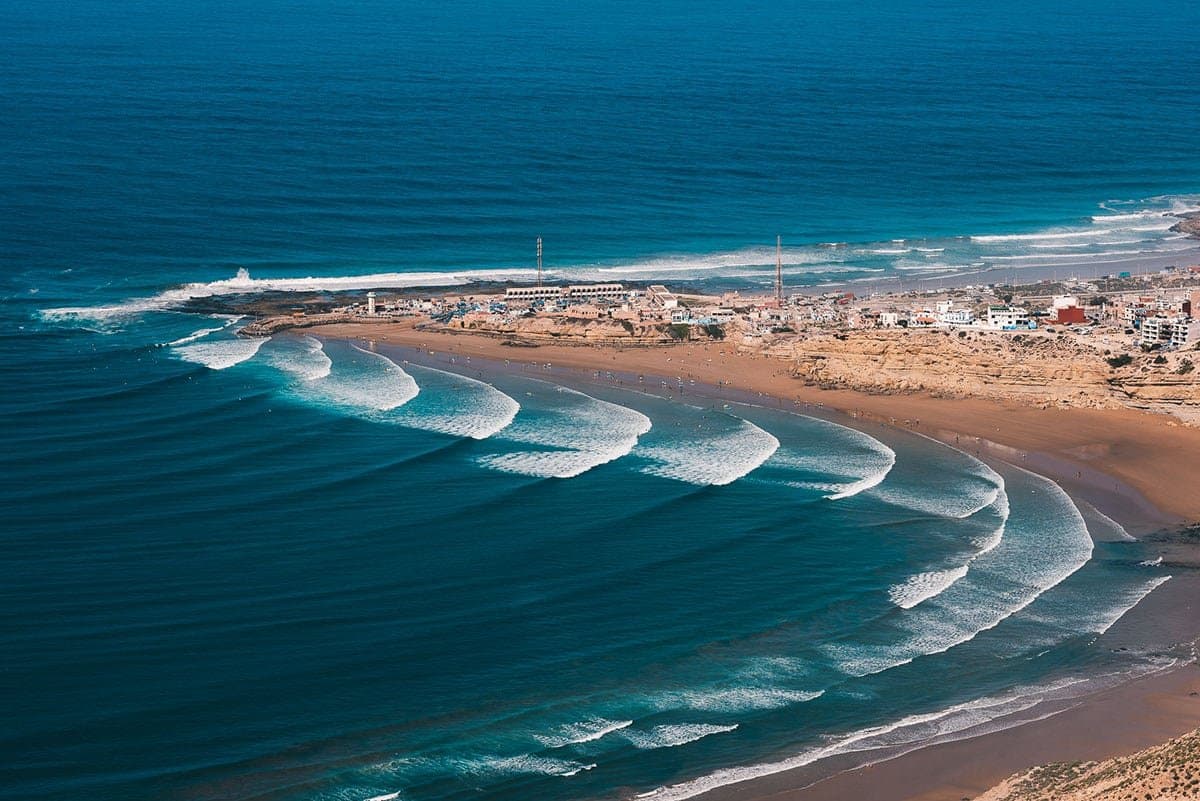
The same Atlantic exposure that makes Imsouane work for surfing also creates the inland rock formations climbers travel for.
How to Combine With an Imsouane Surf Week
The realistic combinations depend on time and which climbing zone matters to you.
Surf-week with day-trip climbing — small bouldering zones in the cliffs above Imsouane harbor. Active rest days only, not a destination.
10-day Imsouane + Tafraout — 5 nights surf, 4 nights climbing in the Anti-Atlas, transit day in between. The most achievable combo.
14-day Imsouane + Todra — 6 nights surf, 7 nights climbing-and-transit. Fly Marrakech-in/out and treat the surf as the trip middle.
14-day Taghia priority + Imsouane recovery — climb Taghia first while fresh, then descend to Imsouane for 4-5 nights of low-impact longboarding. Serious climbers only.
Most multi-sport travelers pick the 10-day Anti-Atlas combo — cleanest geographically, seasons overlap (November-March), and recovery balances naturally.
Recovery Synergies Between Climbing and Surfing
The two sports load the body differently, which is exactly why they pair well across a two-week trip. The basic logic:
Climbing loads forearms, fingers, and contact strength — heavy isometric work in the upper body, controlled lower body, neural focus.
Recovery overlap — three to four days of climbing leaves the forearms shot but the paddling muscles fresh. Switching to surf for 4-5 days uses the unloaded muscle groups while the climbing-specific tissues recover. The reverse also works.
A working pattern we have observed across guest groups: 4 days climbing, then a transit-and-rest day, then 4-5 days of mostly longboarding (the lower-impact mode of the Bay), with one or two shortboard days if energy returns. By the end of the second week, both systems have been worked and partially restored. Guests who try to stack two intense surf days on top of three back-to-back climbing days routinely report shoulder issues by day six.
The Bay at Imsouane is a recovery-friendly surf — slow, mellow, and ideal for active rest after a climbing block.
Gear Logistics
The heaviest pain point is luggage. Realistic packing:
Climbing rack — Anti-Atlas trad: a single cam set (0.3-3) plus nuts. Todra sport: 12 quickdraws and a 60 m rope. Taghia: full alpine kit with doubles and a 70 m rope.
Climbing shoes — bring two pairs. Limestone and quartzite eat rubber; resoling in Morocco is unreliable.
Surfboards — most guests rent at the camp. Flying with a board is 50-100 EUR per leg plus damage risk.
Wetsuits — we provide 3/2 mm steamers in season. Bring your own if you have an unusual size.
Combined luggage — most travelers fit climbing gear in a 23 kg checked bag and rent surf gear locally.
Planning a climbing-plus-surf week? Browse our surf packages for the recovery half of the trip, or message us with your climbing dates and we will help align the surf days.
Multi-sport guests typically arrive with climbing gear and rent surf equipment at the camp.
KAZA Wave’s Approach to Multi-Sport Trips
We are a surf camp, not a climbing operator. What we offer multi-sport guests:
Flexible booking — we hold dates with a small deposit so you can finalize climbing logistics first.
Recovery-focused surf — coaches scale sessions if you arrive with tweaked fingers or sore shoulders.
Longboard-first approach — for climbers wanting low-impact paddling. Slow waves, big board, minimal pop-up effort.
Local driver network — Tafraout transfer is 180-220 EUR shared up to 4 people.
Realistic timing advice — we will tell you when a back-to-back schedule is unrealistic rather than upsell extra days.
Climbing and surfing in Morocco is a credible combo trip if you treat it as two distinct experiences linked by shared logistics, not as a constant-overlap challenge to the body. The Anti-Atlas is the climbing zone closest to Imsouane and the easiest to combine. Ten days is the minimum to get real climbing and real surfing without rushing either; fourteen days is the sweet spot. Build the trip around recovery rhythms — 4 days climb, 4-5 days surf — and you finish stronger than when you started. We see it work every season.
How do climbing and surfing pair physically?
They load different muscle groups. Climbing taxes forearms, fingers, and contact strength; surfing taxes lats, rear deltoids, and core. Switching between them gives natural recovery — fresh paddling muscles when forearms are shot, and vice versa. Avoid stacking 3+ intense climbing days against 2+ heavy surf days back-to-back.
What climbing gear should I bring to Morocco?
For Anti-Atlas trad: a single rack of cams (0.3 to 3), nuts, slings, helmet, and a 60-meter rope. For Todra sport: 12 quickdraws and a 60-meter rope. For Taghia: full alpine kit with doubles, possibly a 70-meter rope. Bring two pairs of climbing shoes if possible.
Can I rent climbing gear in Morocco?
Limited. Tafraout has one or two outfits with basic rental ropes and harnesses. Marrakech has more options but most climbers fly with personal gear. Cams and nuts are generally not available for rent. Soft goods (rope, harness, helmet) are easier to source locally than hardware.
Should I climb first or surf first on a combo trip?
Surf first if you are arriving jet-lagged — the Bay is forgiving and a 5-day surf week eases you into the climate. Climb first if you are time-pressed and need to be sharp for a hard project, then use Imsouane longboarding as recovery in week two. Both patterns work.
How much does a 14-day climbing and surfing trip cost in Morocco?
Realistic budget per person: 1,200-1,800 EUR for two weeks excluding international flights. That covers 7 nights surf camp with half-board, 6 nights Anti-Atlas guesthouses, all transfers, food, and entry fees. Climbing-specific costs (guidebook, local guide if needed) add 100-200 EUR.
Rock Climbing and Surfing in Morocco: A Multi-Sport Adventure | KAZA Wave Blog | KAZA Wave Surf Camp

.jpg)