Breathwork for Surfers: How to Hold Your Breath Under Waves
By Kamal, KAZA Wave Founder — Surf Coach & Camp Owner·July 20, 2026·8 min read
Breathwork for surfers is the most underrated skill in the sport. The surfers who paddle into bigger waves with less anxiety are not the strongest or the fittest — they are the ones who have trained their breath. This guide covers why breath-hold matters, the two methods most relevant to surfing, a 7-day practice plan, and how to behave underwater during a wipeout. We use these drills with intermediate guests at Imsouane as part of the surf-and-yoga retreat.
Safety disclaimer: Breath-hold training carries real risks, including blackout. Never practice breath holds in or under water alone. Never hyperventilate before a hold. The drills described below are designed for dry-land practice on a comfortable surface. Anyone with cardiovascular conditions, asthma, or pregnancy should consult a doctor before starting breath-hold training.
How long can the average surfer hold their breath?
Untrained adults typically reach panic at 20-30 seconds, even though they have 60-90 seconds of safe oxygen. With one week of breathwork practice, comfortable hold time often extends to 45-90 seconds. Trained freedivers reach 3-5 minutes, but that level is unnecessary for surfing — most wipeouts last 5-30 seconds.
What is the best breathwork for surfers?
Box breathing for daily nervous-system stability and pre-session calming, plus Wim Hof method for occasional CO2 tolerance work. Box breathing is safer and more sustainable; Wim Hof produces faster gains in held-exhale tolerance but should not be done daily. Combine both with strict dry-land practice rules.
What should I do during a wipeout?
Wave, curl, wait, surface. Take a full breath as the wave hits, curl into a fetal position with hands over the head, don't fight the spin, wait for the buoyancy to bring you up, then take your first breath when your face clears the water. Fighting the wave wastes oxygen — relaxation conserves it.
About the author
Kamal, KAZA Wave Founder — Surf Coach & Camp Owner. Kamal has lived and surfed in Imsouane for over 15 years. He runs KAZA Wave Surf Camp and teaches longboard surfing to travelers from around the world.
Plan your trip
Book your KAZA Wave surf experience
Small groups, certified coaches, and a wave that breaks for everyone — from beginner to longboard intermediate.
The actual time spent underwater during a typical wipeout is short — usually 5-15 seconds, occasionally up to 30. The problem is not lack of oxygen; it is panic from CO2 buildup. A surfer who has never trained breath-hold experiences the rising-CO2 sensation (chest urgency, throat tightening, panic) at around 20 seconds. A trained surfer feels the same sensation at 60-90 seconds.
That difference is the difference between calm and panic. Calm surfers don’t fight the wave — they let it pass, then surface. Panicked surfers fight, exhaust their oxygen, and surface gasping. The wipeout itself doesn’t change. The relationship to it does.
What breathwork changes:
Increased forced vital capacity (FVC) — pranayama and box breathing expand lung capacity by 7-10% over 12 weeks.
Higher CO2 tolerance — the panic threshold shifts from ~20 seconds to ~60-90 seconds in trained subjects.
Reduced sympathetic activation — the body learns to stay parasympathetic-dominant under stress, which slows heart rate and conserves oxygen.
Better wave-by-wave decision making — calm under stress translates to clearer choices in the lineup.
Breath training on the beach before paddling — the calmest part of the day.
The Wim Hof / Box Breathing Methods
Definition: Wim Hof breathing is a controlled hyperventilation cycle followed by a held exhale. Box breathing is a four-equal-phase cycle of inhale, hold, exhale, hold. Both shift the autonomic nervous system, but through different mechanisms.
Wim Hof Method
How: 30-40 deep breaths in and out (full belly breathing, no force). After the last exhale, hold the breath out as long as comfortable — typically 60-120 seconds for trained subjects. Then take a deep inhale and hold for 15 seconds. Repeat for 3-4 rounds.
Effect: Temporarily lowers CO2 levels, which extends the breath-hold time and creates an alert, energized state. Best done in the morning, before food, on a stable surface. Never in or near water.
Why for surfers: Trains tolerance for the held-exhale state, which is what happens in a wipeout. The held inhale at the end practices retaining a single breath under load.
Box Breathing
How: Inhale 4 counts, hold 4 counts, exhale 4 counts, hold 4 counts. One full cycle is 16 seconds. Repeat for 5-10 minutes.
Effect: Stabilizes the nervous system, slows heart rate, and trains gentle CO2 tolerance without the temporary alkalosis of Wim Hof. Best done before bed, before a session, or any time anxiety builds.
Why for surfers: Pre-session calming. Used by Navy SEALs and freedivers for the same reason — stable nervous system under load. We run a 5-minute box-breathing session on the beach before a big-wave training day.
A 7-Day Practice Plan
One week is enough to feel meaningful change. The plan below builds slowly and never includes water-based holds.
Day 1. 5 minutes of box breathing in the morning. Note your natural breath rate. No holds yet.
Day 2. 10 minutes of box breathing. One round of Wim Hof at the end (30 breaths, hold the exhale, no force).
Day 3. Box breathing in the morning. Two rounds of Wim Hof. Time each held exhale and write it down.
Day 4. Rest from active breathwork. Practice diaphragmatic breathing throughout the day — long exhales, full belly breaths.
Day 5. Three full rounds of Wim Hof. Add a CO2 tolerance table at the end (see below).
Day 6. 10 minutes of box breathing in the morning. Three rounds of Wim Hof. CO2 table after lunch.
Day 7. Full session: 10 minutes box breathing, four rounds of Wim Hof, one CO2 table. Note progress in held exhale time vs day 2.
Most surfers add 30-60 seconds to their comfortable breath-hold over a week. The bigger change is qualitative — the held state stops feeling threatening.
Guided breathwork at the camp — same drills, supervised, with safety protocols.
Breath-Hold During a Wipeout (don’t fight, relax)
The wipeout playbook for surfers, in order:
Take one full breath as the wave hits. Not a panicked gulp — a calm, full inhale through the nose if there’s time, through the mouth if not. The breath you have when you go under is the only one you get.
Curl up. Hands over the head, knees toward the chest. The fetal position protects the head from the board and the bottom, and reduces the surface area the wave can spin.
Don’t fight. The wave will spin you. Trying to swim against it wastes oxygen. Stay loose, let the wave do what it will, and conserve.
Wait for the surface signal. The body floats up naturally as the wave passes — you don’t need to swim toward the surface. Let the buoyancy work.
Surface calm. Once the leash goes slack and you feel the spin slow, swim up. Take your first breath as soon as your face clears the water — not before, not delayed.
The mental script that works for most surfers: “wave, curl, wait, surface.” Run it in your head during practice sessions on the beach. Under stress, the body executes what it has rehearsed.
Dry-land breathwork — the only safe context for breath-hold drills.
CO2 Tolerance Tables
Definition: A CO2 tolerance table is a structured breath-hold drill where the hold time stays constant while rest periods between holds shorten. It trains the nervous system to handle rising CO2 without panic.
A simple beginner CO2 table looks like this:
Round
Rest (breaths)
Hold (seconds)
1
2 minutes
30
2
1:45
30
3
1:30
30
4
1:15
30
5
1:00
30
6
0:45
30
7
0:30
30
8
—
30
Hold time stays at 30 seconds throughout; rest gets progressively shorter. The CO2 builds with each round, training tolerance. Stop immediately if dizzy or lightheaded.
Once the beginner table feels comfortable, increase the hold time to 45 seconds, then 60. Advanced freedivers run tables with 90-second holds and 30-second rests, but that level is unnecessary for surfing — most wipeouts don’t exceed 30 seconds.
How We Practice Breathwork at KAZA Wave Yoga
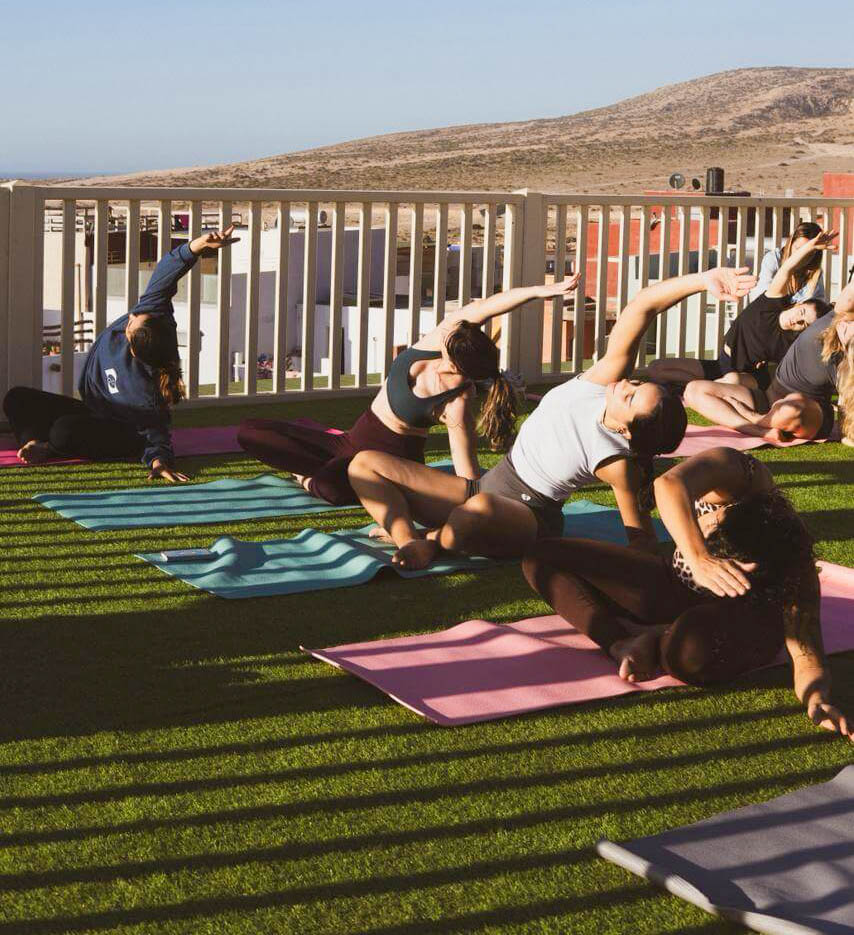
Our surf and yoga retreat integrates breathwork into the daily yoga sessions, not as a separate program. The morning flow ends with 5 minutes of pranayama. The evening restorative session includes long-exhale breathing for parasympathetic activation.
Once or twice per retreat week, we run a dedicated breathwork session — 30 minutes of guided practice including box breathing, alternate-nostril breathing, and a single Wim Hof round. CO2 tables are offered to intermediates who want them, with clear safety instruction. We never practice breath holds in the water at the camp.
The compound effect over a week is significant. Guests who practice breathwork daily report calmer wipeouts, longer sessions without fatigue, and easier sleep. Most take the practice home with them. For the science of how this fits into the broader surf-yoga combination, see why yoga makes you a better surfer. For the morning yoga sequence that primes the body before this work, our morning yoga flow for surfers piece is the same routine we run.
Breathwork won’t make you immune to wipeouts. It won’t make a 6-foot wave smaller. What it does is shift your relationship to the held-breath moment from threat to neutral. That single shift, repeated across a week of surfing, changes how surfers paddle out, what waves they go for, and how they recover from mistakes. Train the breath. The waves don’t change — but you do.
Is the Wim Hof method safe for surfers?
On dry land, with safety protocols, yes. Never in or near water. Never hyperventilate before a held inhale or in any underwater context — this combination is the leading cause of shallow-water blackout. The Wim Hof method on a stable surface, away from water, in the morning, is safe for healthy adults.
How long does breathwork training take to make a difference?
One week of consistent practice typically adds 30-60 seconds to comfortable hold time and produces qualitative shifts in how the held state feels — less threatening, more neutral. After 4-12 weeks, forced vital capacity increases by 7-10%. The biggest gain in the first week is mental, not physical.
What is a CO2 tolerance table?
A breath-hold drill where the hold time stays constant (e.g., 30 seconds) while rest periods between holds shorten progressively. It trains the nervous system to tolerate rising CO2 without panic. A typical beginner table runs 8 rounds with rests dropping from 2 minutes to 30 seconds. Stop immediately if dizzy.
Should beginners do breathwork before surfing?
Box breathing yes, Wim Hof not initially. Five minutes of box breathing on the beach before paddling out calms the nervous system and improves wave selection. Wim Hof method is more advanced and requires understanding of the protocols. Start with box breathing for 1-2 weeks before adding more intense techniques.
Is breathwork part of a KAZA Wave retreat?
Yes, integrated into the daily yoga sessions and offered as dedicated guided sessions once or twice per retreat week. The schedule includes box breathing, pranayama, and supervised CO2 tables for intermediates. We never practice underwater holds at the camp — all breath training is dry-land with safety protocols.
Breathwork for Surfers: How to Hold Your Breath Under Waves | KAZA Wave Blog | KAZA Wave Surf Camp

.jpg)